What Is the Mid-Parental Height Formula?

Mid-parental height formula accuracy is a topic many parents encounter when they first start wondering how tall their child will grow. The formula itself is straightforward: add both parents' heights together, adjust by 13 cm for sex, then divide by two. For boys, the calculation is (father's height + mother's height + 13 cm) / 2; for girls, it is (father's height + mother's height − 13 cm) / 2. The result is often called the target height — the height a child is genetically "supposed" to reach based on parental averages.
This target height formula is popular precisely because it is simple. No lab tests, no appointments, no special equipment — just two numbers and basic arithmetic. Yet pediatric growth specialists routinely see children whose actual adult height lands well outside the range this formula predicts. Understanding why starts with recognising what the formula was designed to do: estimate a population-level average, not predict an individual child's outcome.
Why the Target Height Formula Has a Wide Margin of Error

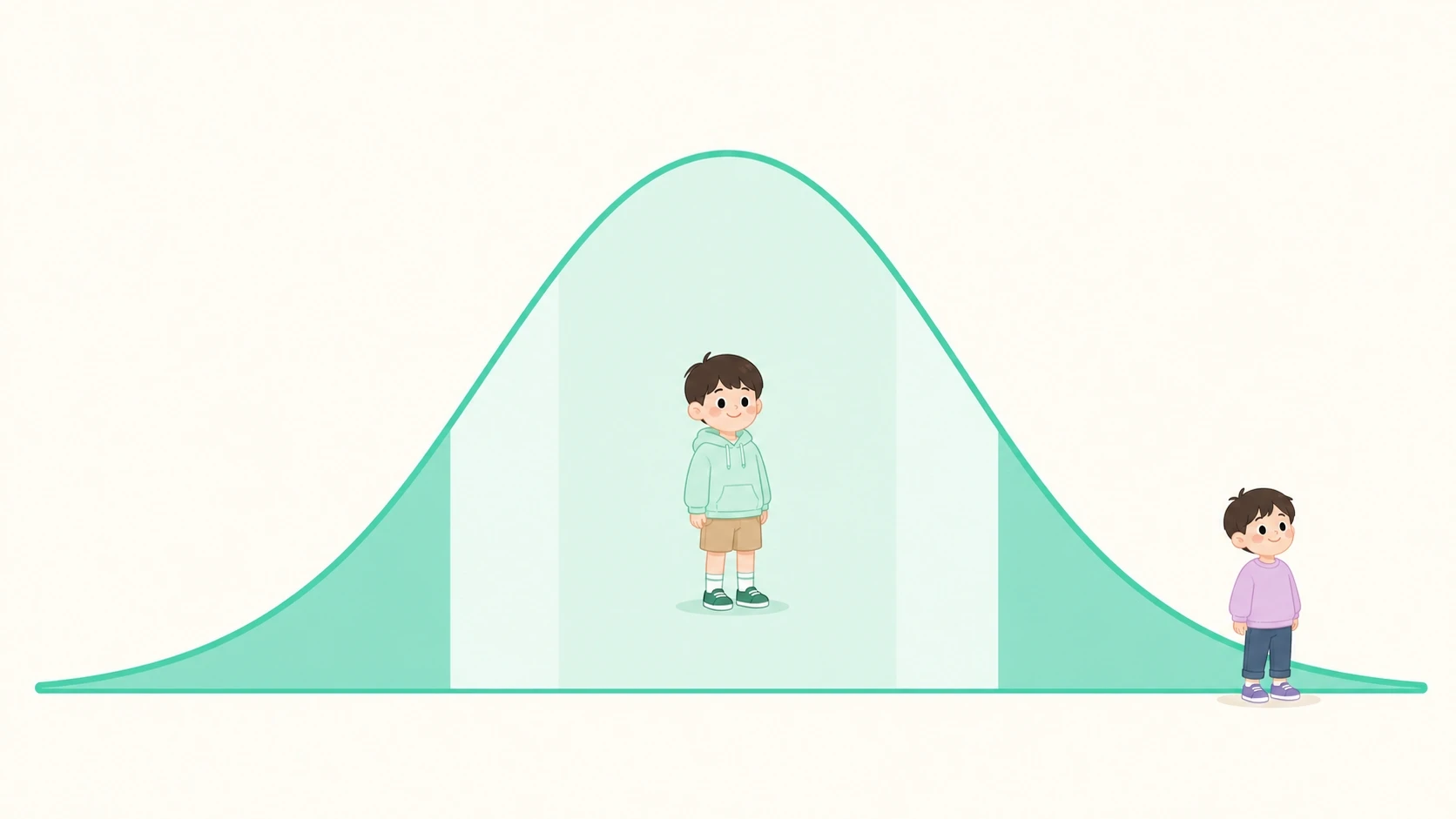
Even in large population studies the target height formula carries a margin of roughly ±8–10 cm around the predicted value. That is a 16–20 cm window — a span that can mean the difference between the 5th and 75th height percentile for a child of a given age. When parents ask how accurate is height prediction from parents, the honest answer is: moderately useful as a range, unreliable as a precise number.
Several structural reasons explain the gap. First, the formula treats parental height as the only input, ignoring that dozens of other genes — including contributions from grandparents, aunts, and uncles — influence a child's stature. Second, it cannot account for the timing and tempo of puberty. A child who enters puberty early will fuse growth plates sooner and often fall short of the formula's prediction, while a late bloomer may exceed it. Third, the formula says nothing about the current state of the growth plates, which is the single most important variable when estimating remaining growth potential.
The Non-Genetic Factors a Predicted Adult Height Calculator Cannot Capture

Genetics accounts for roughly 70–80% of height potential, meaning the remaining 20–30% is shaped by lifestyle, environment, and health. No predicted adult height calculator based on parents can capture these variables — yet they are precisely the factors that parents have the most power to influence.
- Nutrition: Adequate protein, calcium, and vitamin D are non-negotiable for bone lengthening. A diet high in ultra-processed foods and added sugar can trigger early fat accumulation, raise oestrogen levels, and accelerate puberty onset, shortening the window for growth.
- Sleep: The majority of growth hormone is secreted during deep slow-wave sleep. Irregular sleep schedules or insufficient total sleep hours suppress this nightly hormone surge and slow linear growth over time.
- Physical activity: Weight-bearing and jumping exercises stimulate the growth plates and promote natural growth hormone release. Sedentary habits deprive children of this mechanical stimulus.
- Chronic stress: Sustained elevation of cortisol suppresses growth hormone secretion. Children experiencing significant academic pressure or emotional difficulty may show measurably slower growth velocity.
- Medical conditions: Hormonal imbalances such as growth hormone deficiency, hypothyroidism, or precocious puberty can dramatically alter the final outcome in ways no parental-height formula can foresee.
Bone Age: The Variable That Changes Everything

The most important single factor missing from the target height formula is bone age — the biological maturity of a child's skeleton as measured by a hand-and-wrist X-ray. While chronological age simply tracks time since birth, bone age tracks how much growth-plate cartilage has already been used up and how much remains.
A child whose bone age is two years ahead of their chronological age is already consuming their growth window faster than expected. Even if that child's parents are both tall, early growth plate fusion may result in a final height well below what the formula predicted. Conversely, a child with a bone age two years behind their chronological age has more growth potential remaining than the formula suggests, and with the right support could exceed the target height.
Bone age analysis is why a specialist evaluation provides so much more meaningful data than a parental-height calculation. It transforms a statistical guess into a biologically grounded estimate — and, critically, it reveals whether there is still an actionable window to support the child's growth potential.
What a Comprehensive Height Prediction Actually Involves
A thorough assessment of a child's growth potential goes far beyond the mid-parental height formula. Growth specialists integrate multiple data points to produce a clinically meaningful prediction:
- Bone age X-ray: Establishes skeletal maturity and calculates how much growth time remains before plate fusion.
- Growth velocity: Tracking height measurements over 6–12 months reveals whether a child is growing within the expected range for their age and pubertal stage. A velocity below 4 cm per year in a school-age child is a meaningful red flag.
- Pubertal staging: Early puberty dramatically compresses the growth window. Accurate staging identifies whether intervention may be warranted before the plates close.
- Hormonal screening: When indicated, tests for growth hormone secretion, thyroid function, and sex hormone levels can identify treatable causes of slow growth or premature closure.
- Lifestyle audit: Sleep quality, dietary patterns, physical activity, and stress exposure are all assessed as modifiable contributors to growth outcome.
Combining these elements produces a picture of a child's growth trajectory that no online calculator or parental-height formula can replicate.
Practical Steps Parents Can Take Right Now

Understanding the limits of the target height formula should not be a source of anxiety — it should be a prompt to focus on the factors that are genuinely within your control. A few evidence-informed habits make a real difference over the years a child's growth plates remain open.
Prioritise consistent, sufficient sleep. School-age children typically need 9–11 hours and teenagers 8–10 hours; more important than the total is regularity — a fixed bedtime anchors the nightly growth hormone pulse. Offer a diet built around whole proteins, leafy vegetables, dairy or fortified alternatives, and limit heavily processed snacks. Encourage daily movement that includes jumping and running rather than purely sedentary recreation. And pay attention to growth velocity: if your child has not grown at least 5 cm in the past year and is not yet in mid-puberty, that observation is worth raising with a paediatrician or specialist.
If a growth clinic evaluation is on your radar, the earlier it is done, the more options remain available. A specialist can run a bone age assessment to determine how much of the growth window is left — information that turns a vague worry into a clear plan.
FAQ
How accurate is the mid-parental height formula for predicting my child's adult height?
The mid-parental height formula provides a useful population-level estimate with a margin of roughly ±8–10 cm (about ±3–4 inches). This wide range means the formula can be off by more than 15 cm in either direction for an individual child. It does not account for bone age, puberty timing, nutrition, sleep, or medical conditions — all of which significantly influence final height.
Is there a more accurate way to predict my child's adult height than the parent height formula?
Yes. A bone age X-ray combined with a growth velocity assessment by a paediatric growth specialist provides a far more reliable estimate. Bone age reveals how much of the growth window remains, while growth velocity shows whether the child is progressing at an appropriate pace. Hormonal screening can also be added when there is a specific concern.
What should I do if my child seems shorter than the target height formula predicts?
First, measure your child's height twice a year and compare the gain to age-appropriate growth velocity norms (roughly 5–7 cm per year for school-age children). If the annual gain is consistently below that range, consider consulting a paediatric growth specialist. A bone age assessment can clarify whether the growth plates are still open and how much potential remains.
References
- Prediction of adult height from height and bone age in childhood. A new system of equations (TW Mark II) based on a sample including very tall and very short children. Archives of disease in childhood. 1983. PubMed · DOI
- Prediction of adult height from height, bone age, and occurrence of menarche, at ages 4 to 16 with allowance for midparent height. Archives of disease in childhood. 1975. PubMed · DOI
- Adult height in constitutionally tall stature: accuracy of five different height prediction methods. Archives of disease in childhood. 1993. PubMed · DOI
- A New Model of Adult Height Prediction Validated in Boys with Constitutional Delay of Growth and Puberty. Hormone research in paediatrics. 2019. PubMed · DOI
- Prediction of adult height based on automated determination of bone age. The Journal of clinical endocrinology and metabolism. 2010. PubMed · DOI