Why Your Child's Height Is Different Every Single Day

If you are trying to measure child height accurately at home, the first thing to understand is that a child's measured height is not a fixed number — it shifts by up to 1–2 cm over the course of a single day. This is completely normal physiology, not a measurement error or a sign of a growth problem.
The main reason is the spine. The vertebral column is made up of individual bones separated by fluid-filled intervertebral discs. During waking hours, standing, sitting, and moving place constant downward pressure on those discs. Gravity gradually squeezes fluid out of them, shortening the overall length of the spine. By evening, a child can be measurably shorter than they were at breakfast. Overnight, lying flat removes the compressive load and the discs reabsorb fluid, restoring their thickness. Come morning, height is at its daily maximum once again.
Posture, the measurer's technique, and the accuracy of the tool used all add additional variability on top of this natural spinal fluctuation. Knowing this, the real goal of home measurement shifts from "what is today's exact number" to "what is my child's growth trend over time."
The Best Time of Day to Measure Child Height

Because of the disc compression effect, measuring child height correctly requires choosing the right moment. Morning — within 30 to 60 minutes of waking, before extended walking or sitting — captures height at its daily peak. Pediatric growth specialists recommend morning measurements whenever feasible for this reason.
That said, consistency matters more than perfection. If your household routine makes morning measurement difficult, pick a fixed time that works every session and stick with it. Evening measurements at 7 pm every Sunday, for example, are entirely usable for tracking trends as long as the time slot never changes. The data becomes meaningful when the conditions are identical across recordings. Comparing a morning reading from one month to an evening reading from the next introduces unnecessary noise into your growth log and can lead to false conclusions about whether your child has gained or lost height.
One practical tip: avoid measuring directly after your child has been physically active, has been carrying a heavy school bag, or has just woken from a long car journey — all situations that temporarily affect spinal compression.
Step-by-Step: Measuring Child Height Correctly at Home
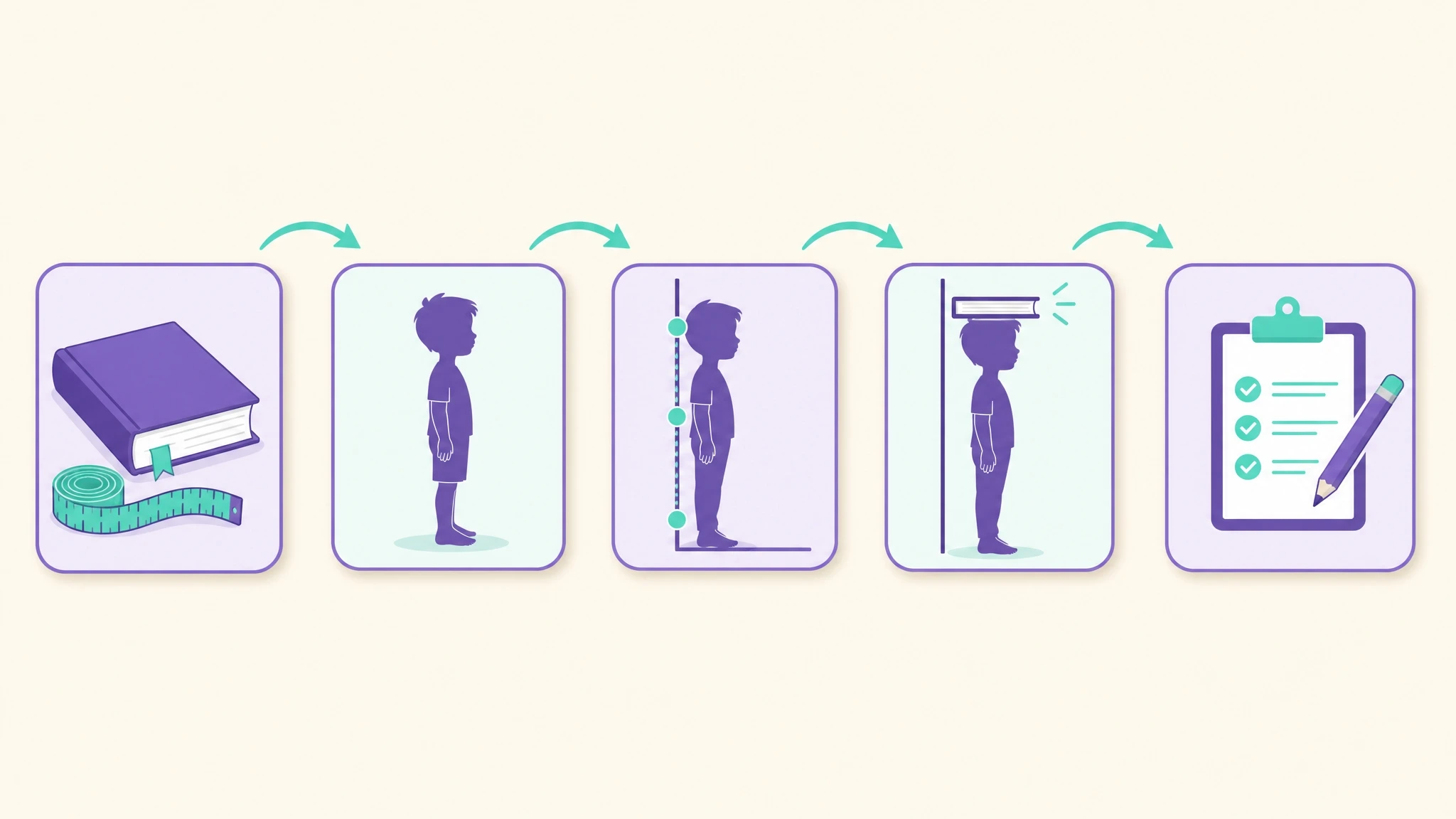
You do not need medical-grade equipment. A steady wall, a flat rigid object, and a reliable tape measure are sufficient. Follow these steps every time to get reproducible results.
- Prepare the space. Choose a wall with a flat, uncarpeted floor at its base. Remove shoes and socks. Light, close-fitting clothing is preferable — thick layers and hooded sweatshirts add bulk that can shift the measurement.
- Position the child correctly. Ask your child to stand with their back, bottom, and shoulder blades lightly touching the wall. Heels should be together and also touching the wall. The chin should be level — neither tilted up nor tucked down — so that the bottom of the eye socket and the top of the ear canal form a horizontal line (this is called the Frankfort plane).
- Place the headboard object. Lay a hardback book or a rigid flat box on top of the child's head, pressing it gently but firmly down through the hair until it touches the scalp. Keep it perfectly horizontal and bring its back edge flush with the wall.
- Mark and measure. Have your child step away, then mark the wall precisely where the bottom edge of the book or box meets the surface. Measure from the floor to that mark with a metal or fiberglass tape measure — avoid cloth tapes that can stretch. Record the result in centimeters to one decimal place.
- Repeat twice more. Take three readings in succession and record all three. Use the median (middle) value, or the average if all three are close. This repeat-measure approach is the single most effective step for measuring child height correctly and canceling out the tiny wobbles that occur between readings.
How Often Should You Actually Measure?

Many parents check height weekly or even daily, hoping to catch every millimeter of progress. In practice, this creates more confusion than clarity — because child height varies morning vs evening by up to 2 cm naturally, frequent measurements without strict time controls produce a noisy dataset that is difficult to interpret.
Growth specialists generally recommend a monthly or quarterly measurement schedule. Over a full year, monthly readings give 12 data points — more than enough to identify whether a child is tracking along their growth curve, accelerating, or falling behind. Quarterly checks are appropriate for older children whose growth rate has slowed. Annual school physical measurements, while useful as a benchmark, are too infrequent to detect early changes in growth velocity.
When you do measure, log the date, the time, and the value together. A simple notebook, a dedicated spreadsheet, or a growth-tracking app all work equally well. The habit of consistent logging transforms isolated numbers into a meaningful growth story that you can share with a pediatrician if any questions arise.
Common Mistakes That Skew Your Readings

Even parents who are measuring child height correctly in principle often introduce small but consistent errors. Here are the most frequent ones to avoid.
- Using a stretch tape or sticker ruler. Fabric tapes elongate with use, and the adhesive ruler strips sold for children's bedroom walls are often printed at a slight scale inaccuracy. A metal or fiberglass tape measure is far more reliable.
- Inconsistent posture. Children naturally slouch, tilt the chin, or shift their weight between sessions. Gently coaching the same posture every time — heels to wall, chin level — prevents this source of variability from masquerading as a growth change.
- Measuring after physical activity. An afternoon of sport or a long school day involving a heavy backpack compresses spinal discs more than usual. Measure before these activities or allow an hour of rest first.
- Pressing the book too hard or too lightly. The headboard object should compress the hair gently to reach the scalp without pushing the head down. Too much pressure artificially lowers the mark; too little leaves a gap.
- Worrying about the "growth plate damage" myth. Measuring height does not affect growth plates in any way. This is a misconception with no scientific basis. Height measurement is entirely safe and should be done regularly without concern.
When to Bring Your Records to a Professional

Tracking height at home gives you valuable longitudinal data, but there are situations where home records should prompt a visit to a pediatric growth specialist. If your child grows less than approximately 4–5 cm per year during the primary school years, if they have dropped one or more major percentile channels on a standard growth chart, or if you notice that puberty signs are appearing either much earlier or much later than expected for their age, these are all reasons to seek a professional evaluation.
A growth specialist can supplement your home records with a bone age X-ray, which reveals how much growth potential remains by comparing skeletal maturity to chronological age. This combination — your carefully logged home measurements plus a clinical assessment — provides the most complete picture of a child's growth trajectory. Families who notice a concern early consistently have more treatment options available than those who wait.
Your home measurement habit is genuinely useful clinical data. Bring your logbook or app records to any appointment — a growth trend over 12 months tells a specialist far more than a single in-clinic measurement taken in isolation.
FAQ
Why does my child's height change between morning and evening?
The difference is caused by the intervertebral discs in the spine. During the day, gravity and activity gradually compress these fluid-filled discs, shortening the spine by up to 1–2 cm. During sleep, the discs rehydrate and return to full thickness, so morning height is the tallest of the day. This fluctuation is entirely normal and does not indicate a growth problem.
How often should I measure my child's height at home?
Monthly or quarterly measurements are enough for most families. Measuring more frequently — weekly or daily — without strict time controls produces noisy data that is difficult to interpret because of the natural morning-to-evening variation. Monthly measurements taken at the same time of day give a clear, reliable trend over time.
What is the most accurate way to measure child height at home?
Stand your child barefoot against a flat wall with heels, bottom, and shoulder blades touching the surface. Keep the chin level so the eye and ear form a horizontal line. Place a rigid book or flat box on top of the head and bring it gently to the scalp, then mark the wall where the book meets it. Measure from the floor to the mark with a metal or fiberglass tape. Take three readings and use the median value. Measuring in the morning, before extended activity, gives the most consistent results.
References
- Prediction of adult height using maturity-based cumulative height velocity curves. The Journal of pediatrics. 2005. PubMed · DOI
- Prediction of adult height from height and bone age in childhood. A new system of equations (TW Mark II) based on a sample including very tall and very short children. Archives of disease in childhood. 1983. PubMed · DOI
- Adult height in constitutionally tall stature: accuracy of five different height prediction methods. Archives of disease in childhood. 1993. PubMed · DOI
- Variation in methods of predicting adult height for children with idiopathic short stature. Pediatrics. 2010. PubMed · DOI
- Prediction of adult height based on automated determination of bone age. The Journal of clinical endocrinology and metabolism. 2010. PubMed · DOI