How predicted height is calculated
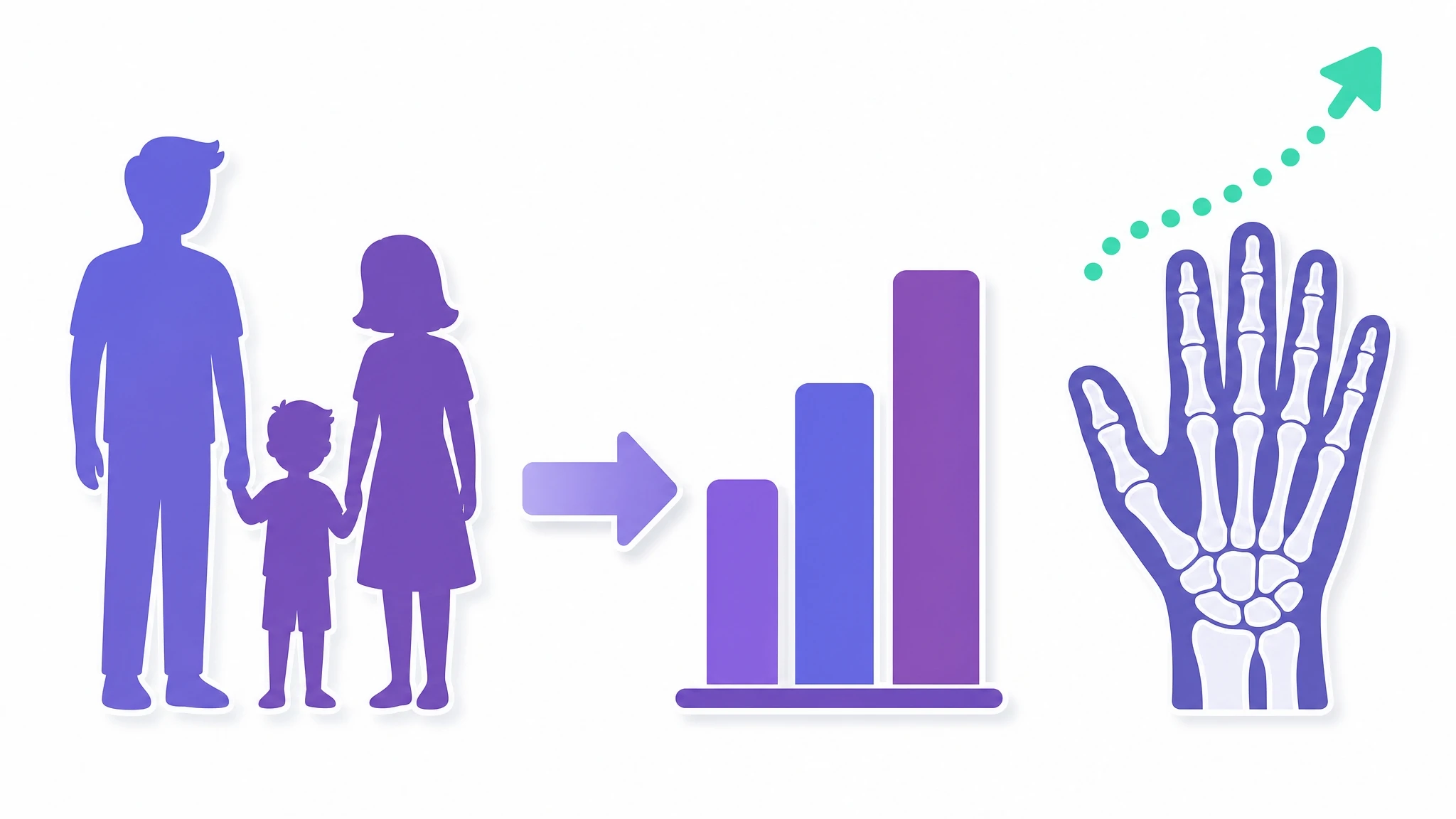
To respond properly when the predicted height comes out low, you first need to understand how that number is produced. There are broadly two ways to calculate predicted height. The first is genetic predicted height (Target Height), a method that adds the father's and mother's heights and applies them to a formula. For boys it is calculated as (father's height + mother's height + 13) ÷ 2, and for girls as (father's height + mother's height − 13) ÷ 2. This figure only shows genetic potential; it does not fix the child's final height. The second is predicted height based on bone age. After measuring growth-plate maturity with a left-hand X-ray, a statistical formula such as Bayley-Pinneau is applied to predict final height. The 'predicted height' commonly referred to at growth clinics is mostly this bone-age-based figure. Whichever method is used, it is important to remember that it is ultimately a 'statistical prediction,' not a definitive verdict.
The reliability of predicted height — how much should you trust this number

Many parents despair when the predicted height comes out low, but the reliability of predicted height has clear limitations. There is a measurement error of about ±1 year in the bone-age reading itself, and because growth-prediction formulas apply population statistics to an individual, a discrepancy of around ±5 cm from the actual result can occur. In particular, the 'maturity' of the growth plates can be grasped through X-ray, but how actively the growth plates will grow over the remaining period cannot be fully predicted from the number alone. In addition, because predicted height is based on the current growth pattern, if the nutrition, sleep, and exercise environment changes afterward, the actual growth result can change as well. Keep in mind that a predicted height coming out low after a bone-age test is a conditional figure meaning 'if this current state continues.'
4 reasons a child can grow taller even with a low predicted height

It is easy to give up when the predicted height comes out low, but cases where the actual final height exceeds the prediction are not rare. Let me look at the reasons in detail.
- The effect of improving the growth environment: Predicted height is calculated based on lifestyle habits up to now. If you systematically manage sleep, nutrition, and exercise starting now, you can draw out additional potential during the period when the growth plates are still open.
- The pubertal growth spurt: There are cases where a child who grew gradually before puberty grows explosively during puberty. Just because the current growth rate is slow does not mean that this rate will be maintained in the future.
- The possibility of treating a medical cause: If there is a cause such as growth hormone deficiency or a thyroid abnormality, appropriate treatment can change the growth trajectory itself. In such cases, you can expect growth that far exceeds the prediction.
- The margin of error in bone-age measurement: Taking into account the ±5 cm error mentioned earlier, there is ample possibility that the actual final height will be several centimeters taller than predicted.
What parents should do when the predicted height comes out low

The key to responding when the predicted height comes out low is to carry out an accurate identification of the cause and a review of the living environment at the same time.
- Consult a pediatric growth specialist: If the predicted height came out low after a bone-age test, you need to confirm through blood tests and detailed diagnosis whether it is a simple genetic issue or whether there is a medical cause such as growth hormone deficiency, thyroid abnormality, or early maturation. Depending on the cause, not missing the treatment window is important.
- Secure balanced nutrition: Consume sufficient protein, calcium, and vitamin D, and cut down on sweet foods and fast food that spike blood sugar sharply.
- Establish sleep habits: Growth hormone is secreted most actively during deep sleep (slow-wave sleep). Aim for 9 to 11 hours of sleep for elementary schoolers and 8 to 10 hours for middle and high schoolers, keeping a regular bedtime.
- Growth-plate-stimulating exercise: Consistently doing aerobic exercise such as jump rope, basketball, and running 3 to 5 times a week for 30 minutes or more each time helps stimulate the growth plates and promote growth hormone secretion.
- Record height measurements periodically: Measuring and recording height at least once every 3 months at the same time and by the same method lets you catch changes in growth rate early.
Predicted height after a bone-age test — when should you respond proactively

There are cases where you especially need to hurry when the predicted height comes out low after a bone-age test. When the bone age is 1.5 years or more ahead of the actual age, the growth plates are more likely to close early, so the remaining growth period is short. Conversely, when the bone age is younger than the actual age, it means more growth period remains, so there is room to exceed the prediction through environmental improvement alone. If growth is slow at under 4 cm per year, or if height is at or below the 3rd percentile compared to peers, confirming the medical cause of the poor growth is recommended. The best response is to not miss the treatment start window through a growth clinic's detailed examinations (blood tests, growth hormone stimulation tests, bone age). Clinical data consistently show that when treatment is needed, the earlier it begins, the greater the effect.
Predicted height is a starting point, not a destination

When the predicted height comes out low, accepting that number as a fixed verdict on the child's future is not medically correct either. Predicted height is a statistical prediction based on the growth state and bone age at this point in time, and the reliability of predicted height includes a ±5 cm margin of error. What matters is using this figure as an occasion to review the child's growth environment and, if necessary, to seek professional help. Sleep, nutrition, and exercise habits for growth are beneficial to every child regardless of predicted height. If a medical cause is found, starting treatment at the appropriate time can have a positive effect on final height. Predicted height is a tool that tells you the starting line, not a number that declares the limit of possibility. Putting into practice, one by one, the things you can do beside your child right now is the wisest response.
FAQ
How accurate is a predicted adult height based on bone age?
Bone age-based height predictions typically have a margin of error of roughly ±5 cm (about 2 inches). The estimate is a useful range, not a guaranteed outcome. Factors like reader variability, formula limitations, and changes in growth conditions all affect how close the final height comes to the prediction.
Can a low predicted height change with treatment or lifestyle changes?
Yes. Predicted height can change with treatment when an underlying medical condition — such as growth hormone deficiency or hypothyroidism — is identified and addressed. Even without a medical diagnosis, consistent improvements in sleep, nutrition, and physical activity during the remaining growth period can push outcomes meaningfully above initial estimates.
How reliable is a predicted height from the parent height formula versus a bone age X-ray?
The mid-parental height formula based on parent heights reflects genetic potential only and has a wider margin of error. Bone age X-ray predictions are more individualized because they account for the child's actual skeletal maturity and remaining growth time, making them the more clinically reliable of the two methods — though still an estimate.
References
- Variation in methods of predicting adult height for children with idiopathic short stature. Pediatrics. 2010. PubMed · DOI
- Prediction of adult height from height and bone age in childhood. A new system of equations (TW Mark II) based on a sample including very tall and very short children. Archives of disease in childhood. 1983. PubMed · DOI
- Accuracy of final height prediction and effect of growth-reductive therapy in 362 constitutionally tall children. The Journal of clinical endocrinology and metabolism. 1996. PubMed · DOI
- A New Model of Adult Height Prediction Validated in Boys with Constitutional Delay of Growth and Puberty. Hormone research in paediatrics. 2019. PubMed · DOI
- Prediction of adult height from height, bone age, and occurrence of menarche, at ages 4 to 16 with allowance for midparent height. Archives of disease in childhood. 1975. PubMed · DOI