Is Your Child's Height Really All About You?

When it comes to grandparents height genetics children, most parents look no further than themselves — and that is a natural starting point. Research consistently shows that genetics accounts for roughly 80% of a child's final height, with environment making up the remaining 20%. The most direct contributors are, of course, mom and dad. Pediatric growth specialists even use a mid-parental height formula — averaging the two parents' heights — as a quick baseline estimate.
Yet every experienced clinician has encountered the same puzzling scenario: two tall parents whose child falls noticeably short for their age, or two petite parents whose child shoots past them before middle school. These cases are not errors in the data. They point to a far more complex reality: height inheritance is multigenerational, and the influence of grandparents on a child's stature is often underestimated.
Does Height Skip a Generation? The Science of Atavism

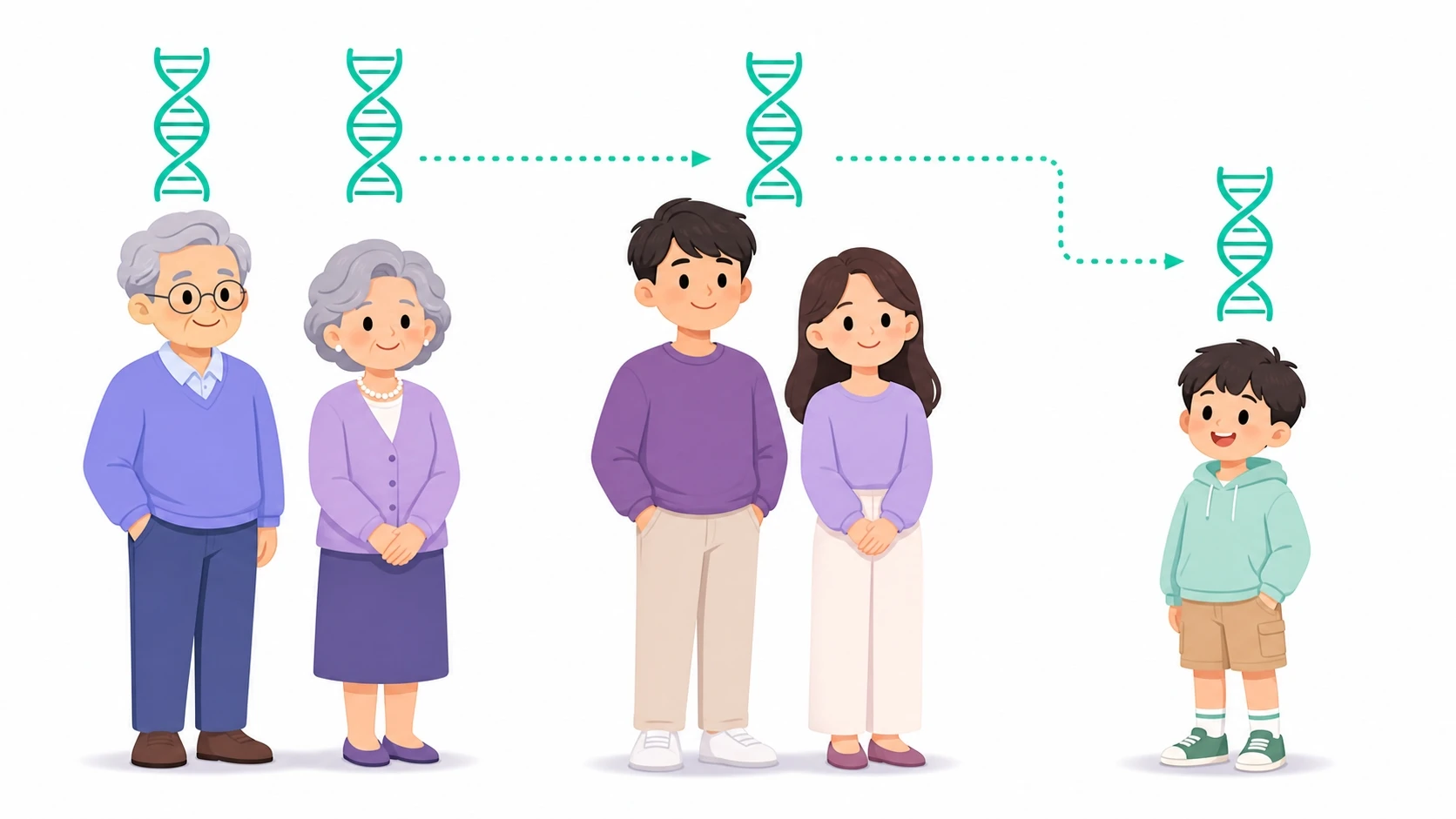
The short answer is yes — height can and does skip a generation, and the mechanism behind this is known as atavism, or more precisely, multigenerational height inheritance. Every cell in your child's body carries DNA received equally from both parents. But not every gene is switched on. Some genes are dominant and express themselves immediately; others are recessive and remain dormant, sometimes for an entire generation, before re-emerging in a grandchild.
Height is controlled not by one gene but by hundreds of interacting variants. A parent may carry a cluster of recessive "short" genes from their own parents without those genes having any visible effect on the parent's stature. When two of these recessive variants meet in the child — one from each parent's inherited copy — they can express fully. The reverse is equally possible: a child inherits a dormant cluster of "tall" genes from grandparents that bypassed the parent generation entirely.
This is why grandparent height influence deserves a seat at the table whenever a family is trying to understand their child's growth trajectory.
Real Clinical Patterns: When the Grandparent Effect Shows Up

In growth clinics, the grandparent height influence surfaces in two common presentations. The first is a child who is measurably shorter than peers despite having two tall parents. When the clinician asks about the family tree, it often turns out that one or both sets of grandparents were notably short — and that recessive heritage has re-emerged in the grandchild.
The second pattern is the opposite: parents who assume their child will be short simply because both of them are, without realizing that a grandparent on either side was tall. In these families, the child may carry dominant height genes that skipped the parent generation and will express fully given the right nutritional and lifestyle environment.
Neither outcome can be reliably predicted by a mid-parental formula alone. A meaningful assessment of multigenerational height inheritance requires gathering a four-generation height history — both sets of parents and both sets of grandparents — to identify which patterns are likely dominant and which are recessively dormant.
Familial Short Stature: Spotting It Early With Grandparent Data
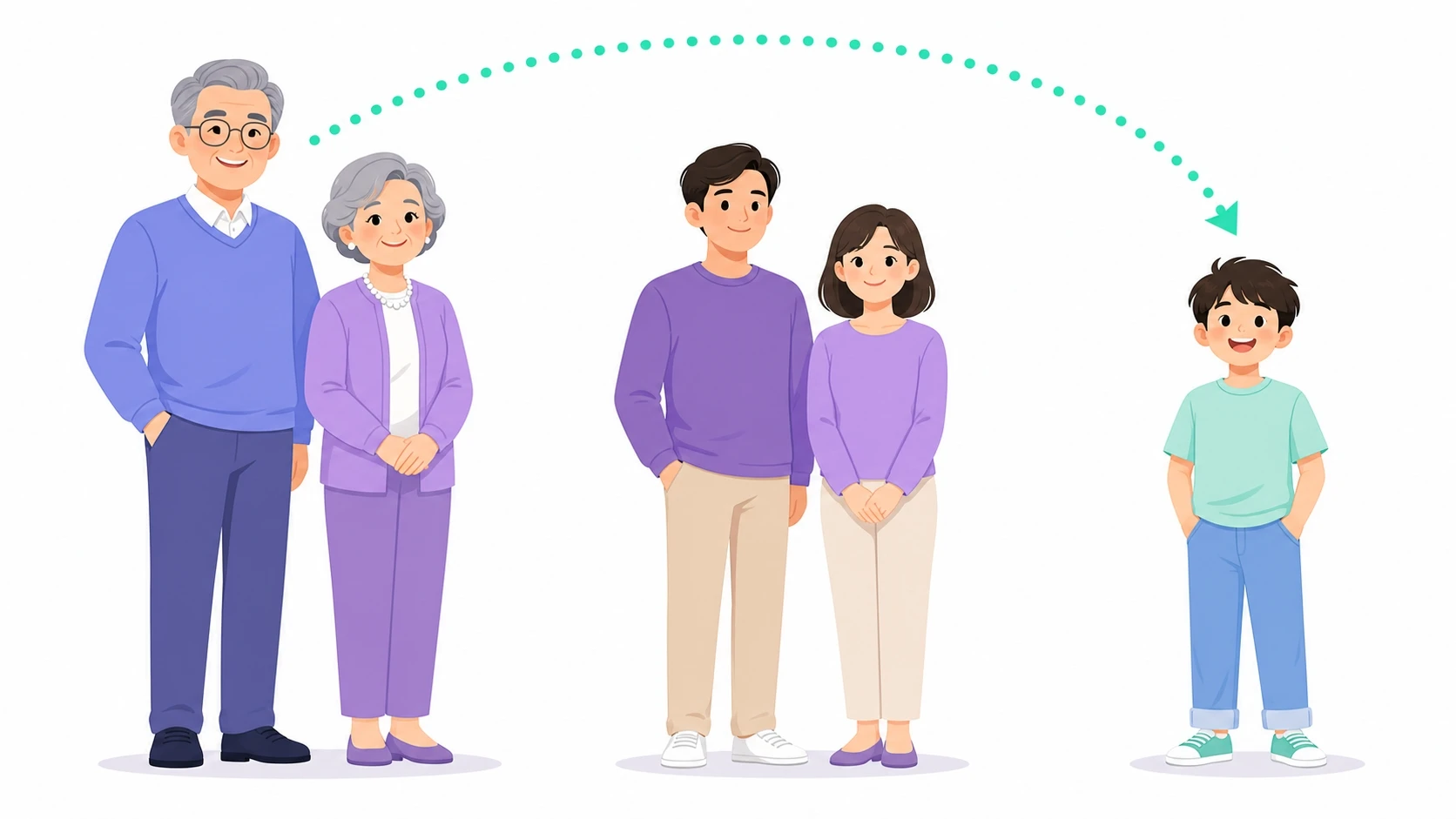
One of the most practical reasons to map grandparents height genetics in children is the early identification of familial short stature — a condition in which a child is genuinely short due to inherited genetic patterns rather than hormonal or nutritional deficiencies. Because atavism means that even tall parents can pass on recessive short-stature genes from their own parents, familial short stature can appear unexpectedly.
Identifying it early matters enormously. Growth plates — the cartilage zones where long bones lengthen — close progressively through puberty, and the window for intervention narrows with every year. A thorough evaluation typically includes the child's current height, annual growth velocity, a bone age X-ray, and a detailed family history that explicitly includes grandparent heights.
When grandparent data reveals a pattern consistent with familial short stature, a growth specialist can model the child's likely trajectory and, where clinically appropriate, discuss options that may support the child in reaching closer to their biological ceiling before that window closes.
Building a Four-Generation Height Map for Your Child

Parents rarely think to document grandparent heights systematically, yet this information is among the most actionable data you can bring to a growth consultation. Before your child's next checkup, try to record the adult heights of all four grandparents as accurately as possible — ideally from measurement rather than self-report, which tends to skew slightly tall.
Combine this with both parents' heights, the child's current height and percentile, and any known growth patterns in siblings or cousins. This four-generation map transforms a one-dimensional mid-parental estimate into a richer probabilistic picture. A clinician reviewing it can weigh which side of the family carries dominant height alleles versus recessive ones, and whether the child appears to be tracking toward the grandparent-influenced end of the spectrum.
Understanding does height skip a generation in your own family is not about anxiety — it is about informed planning. The earlier a multigenerational pattern is recognized, the more options remain available.
What a Growth Specialist Can Tell You That a Calculator Cannot
Online height predictors and simple formulas offer a rough starting point, but they lack two things that a specialist evaluation provides: bone age assessment and multigenerational context. A bone age X-ray reveals whether a child's skeleton is maturing ahead of or behind their calendar age — critical information for estimating how much growth time remains. Layered onto that, a clinician who factors in grandparents height genetics children data can distinguish between a child who is short but on a healthy family-typical curve and a child whose growth velocity has actually slowed in ways that warrant closer attention.
When both pieces point in the same direction — delayed bone age, below-midparental height, short grandparents in the family history — a tailored growth strategy becomes possible. This may involve lifestyle coaching around sleep, nutrition, and targeted exercise, or in some cases a clinical referral for more detailed hormonal workup. The goal is always to help the child reach as much of their biological potential as possible, not to override genetics but to optimize everything within their control.
FAQ
Does height actually skip a generation?
Yes, it can. Height is influenced by hundreds of genes, some of which are recessive and may be dormant in a parent but re-express in a grandchild. This is why children sometimes end up significantly taller or shorter than both parents, more closely matching a grandparent's stature instead.
How much does grandparent height influence a child's final height?
There is no fixed percentage, because grandparent height influence depends on which specific gene variants were inherited and how they interact. However, family history studies consistently show that including grandparent heights improves the accuracy of adult height predictions compared to using parent heights alone.
When should I bring up grandparent heights with a growth specialist?
Bring it up at any consultation where your child's height is discussed — especially if your child is below the 3rd to 5th percentile for their age or growing noticeably slower than peers. Recording the adult heights of all four grandparents before the appointment gives the clinician the most complete picture for assessing multigenerational height inheritance patterns.
References
- A Polygenic Risk Score to Predict Future Adult Short Stature Among Children. The Journal of clinical endocrinology and metabolism. 2021. PubMed · DOI
- Predicting human height by Victorian and genomic methods. European journal of human genetics : EJHG. 2009. PubMed · DOI
- Prediction of Adult Height by Machine Learning Technique. The Journal of clinical endocrinology and metabolism. 2021. PubMed · DOI
- Prediction of adult height using maturity-based cumulative height velocity curves. The Journal of pediatrics. 2005. PubMed · DOI
- Variation in methods of predicting adult height for children with idiopathic short stature. Pediatrics. 2010. PubMed · DOI