Why Most Parents Miss the Very First Sign

The first signs of puberty in boys tend to go unnoticed far longer than in girls — and there is a biological reason for that. When parents think about male puberty, they usually picture the dramatic changes: the voice dropping, a sudden growth spurt, or the first signs of facial hair. But those changes appear relatively late in the process. The earliest biological signal is quiet, internal, and easy to overlook: enlargement of the testicles.
Understanding why this is the true starting point — and what to watch for after it — helps parents track their son's development accurately and catch potential concerns like early puberty signs in boys well before other changes become obvious.
The Biology Behind the First Signal: The HPG Axis

Puberty begins in the brain, not the body. The hypothalamus sends a hormonal signal to the pituitary gland, which in turn instructs the testes to start producing testosterone. This chain — called the hypothalamic-pituitary-gonadal (HPG) axis — is the ignition switch for everything that follows.
As the testes begin producing testosterone, they grow first. This is why testicular enlargement is the most accurate early biological marker of puberty in boys. Everything else — pubic hair, height acceleration, voice change — emerges only after the testes have been producing enough testosterone for weeks or months. According to the Tanner stages boys develop through, Stage 2 begins specifically when testicular volume exceeds 4 mL or when the longest axis measures more than 2.5 cm. Parents who only watch for visible secondary changes may miss this initial window by six months to a year.
The Tanner Stages in Boys: A Timeline Parents Can Follow

The Tanner stages boys progress through describe puberty as a sequence rather than a single event. Here is how the typical timeline unfolds after testicular growth begins:
- Pubic hair (6–12 months after Stage 2): Fine, sparse hair appears near the base of the penis. It gradually darkens and thickens over the following months.
- Growth spurt (roughly 12 months after onset): Boys gain 8–12 cm per year during peak velocity — the fastest growth since infancy. This is the height surge parents often notice first, but it comes after puberty is already well underway.
- Penile growth: Length and girth increase gradually alongside testicular development.
- Voice change (mid-puberty): The larynx enlarges and the vocal cords thicken, causing the voice to deepen — sometimes unevenly at first.
- Axillary hair and early facial hair: Underarm hair and light hair on the upper lip or chin typically appear in the later stages.
- Muscle mass and shoulder width: Testosterone drives significant increases in lean muscle and broadening of the shoulders.
- Acne: Increased sebaceous gland activity often brings breakouts on the face, back, and chest.
The full progression from Stage 2 to Stage 5 typically spans three to five years. The puberty age boys average for Stage 2 onset is between 9 and 14 years.
What Is a Normal Puberty Age for Boys?

There is meaningful variation in the puberty age boys average experience. Testicular development typically begins somewhere between ages 9 and 14, with most boys starting around 11 to 12 years old. Starting at 9 or as late as 14 can still fall within the normal range. The challenge for parents is that "normal" covers a five-year window, so comparing one child to his classmates is rarely informative.
A more useful approach is to watch for the sequence of changes described above rather than focusing on any specific age. If a boy's development seems to be following the expected pattern — even if the timing is earlier or later than peers — that is generally reassuring. What warrants closer attention is development that begins before age 9 or that appears to stall at one stage without progressing over 18 months or more.
Early Puberty Signs in Boys: When to Pay Closer Attention
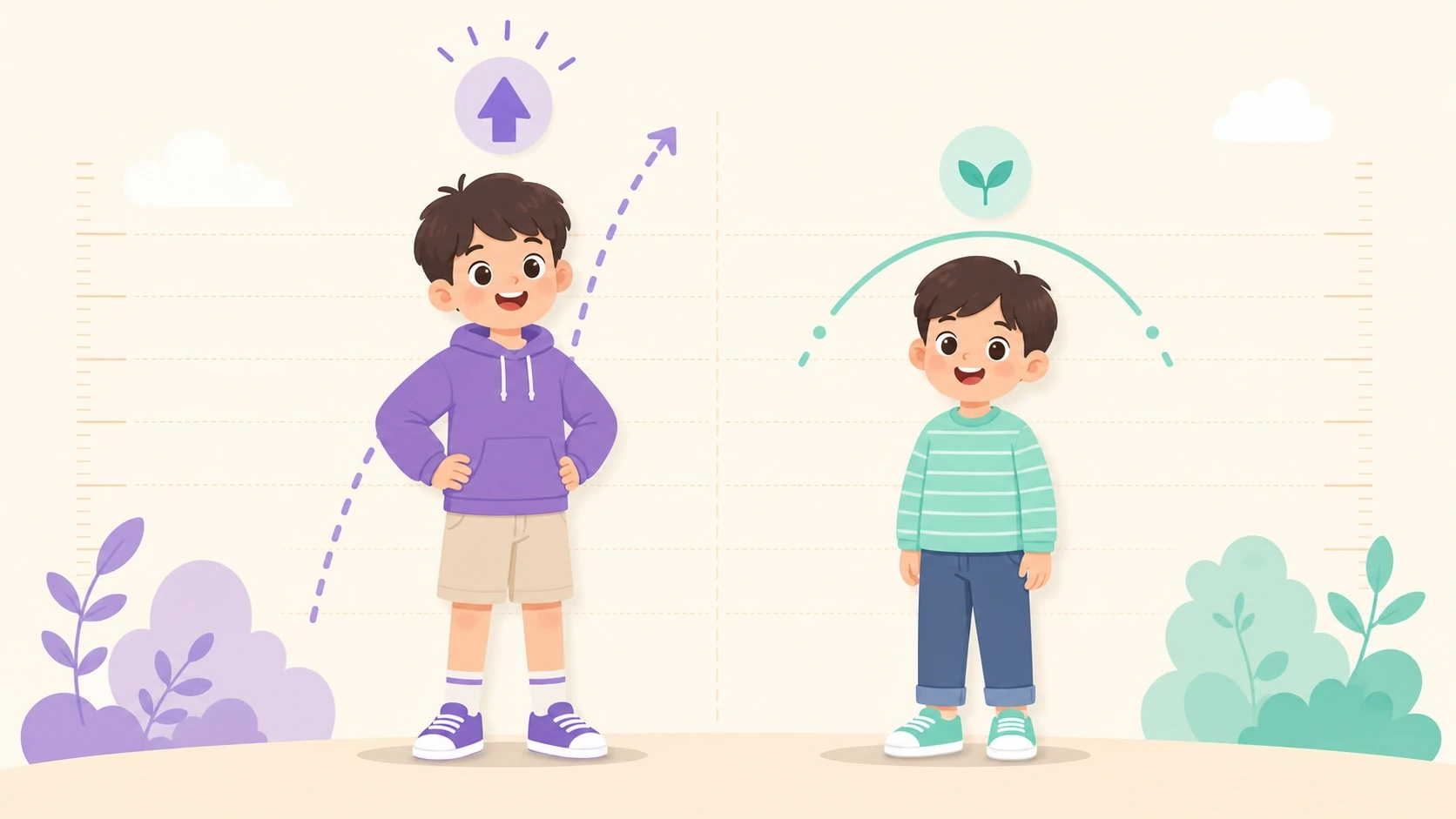
When testicular volume exceeds 4 mL before age 9, pediatric guidelines classify this as precocious puberty. Early puberty signs in boys are less common than in girls, but they carry important consequences for final adult height. When puberty starts early, the growth plates — the active cartilage zones where bones lengthen — receive a signal to mature and close sooner than expected. A boy who enters puberty at age 7 may grow rapidly for a year or two, then stop growing years before his peers.
Beyond height, early puberty can create social and emotional strain. Boys who develop significantly ahead of their classmates often report self-consciousness and difficulty fitting in.
The good news is that early puberty in boys is diagnosable with a physical examination, a bone age X-ray, and hormone blood tests. When identified early, medical management can preserve growth potential and allow development to proceed at a more appropriate pace. If you notice any early puberty signs in boys younger than 9, consulting a pediatric growth specialist is a reasonable next step.
Supporting Healthy Development: What Families Can Do
Most of the time, puberty unfolds without any intervention needed. However, parents can create conditions that support healthy development throughout this phase:
- Sleep: Growth hormone secretion peaks during deep sleep. Maintaining consistent, adequate sleep — at least 9 hours for school-age boys — protects the hormonal environment supporting growth.
- Nutrition: Adequate protein, calcium, and vitamin D remain important through puberty. Boys in their growth spurt have significantly higher caloric and protein needs than they did two years earlier.
- Physical activity: Weight-bearing exercise like running, jumping, and court sports provides mechanical stimulation to growth plates. Avoiding extreme training loads that could stress developing joints is equally important.
- Stress management: Chronically elevated cortisol can blunt growth hormone release. Academic pressure and over-scheduling are worth monitoring during the growth-spurt years.
If you have concerns about the timing or pace of your son's development, a pediatric growth specialist can assess bone age, measure testicular volume, and check hormone levels to give you an accurate picture of where he stands.
FAQ
What is the very first sign of puberty in boys?
The first sign is testicular enlargement — specifically, testicular volume reaching 4 mL or the longest axis exceeding 2.5 cm. This typically precedes all other visible changes, including pubic hair and height acceleration, by six months to a year. It corresponds to Tanner Stage 2 on the standard puberty scale.
What is the average age for boys to start puberty?
Most boys begin puberty between ages 9 and 14, with an average onset around 11 to 12 years. Starting at either end of this range can still be normal. Puberty beginning before age 9 is considered early and warrants evaluation by a pediatric specialist.
Can early puberty affect how tall my son will be as an adult?
Yes. Boys who enter puberty significantly early may experience a rapid but shorter growth window because their growth plates close earlier than those of peers who develop on schedule. Early diagnosis allows specialists to assess growth plate status through bone age X-ray and, when appropriate, discuss options to help preserve predicted adult height.
References
- Timing of Puberty in Overweight Versus Obese Boys. Pediatrics. 2016. PubMed · DOI
- Obesity Is Associated with Earlier Pubertal Onset in Boys. The Journal of clinical endocrinology and metabolism. 2021. PubMed · DOI
- Total and Central Adiposity Are Associated With Age at Gonadarche and Incidence of Precocious Gonadarche in Boys. The Journal of clinical endocrinology and metabolism. 2021. PubMed · DOI
- Effects of obesity on human sexual development. Nature reviews. Endocrinology. 2012. PubMed · DOI
- Childhood obesity and the timing of puberty. Trends in endocrinology and metabolism: TEM. 2009. PubMed · DOI