Why the Questions Matter More Than the Answers

Growth treatment runs for years, costs real money and happens during a window that does not reopen. It deserves the same scrutiny as any other long commitment.
These seven questions are not a test with right answers. They are the questions that reveal whether a clinic is building a plan around your child or fitting your child into a plan it already had.
They apply anywhere — in Seoul, and equally at home.
1. What Will You Test Before Recommending Anything?
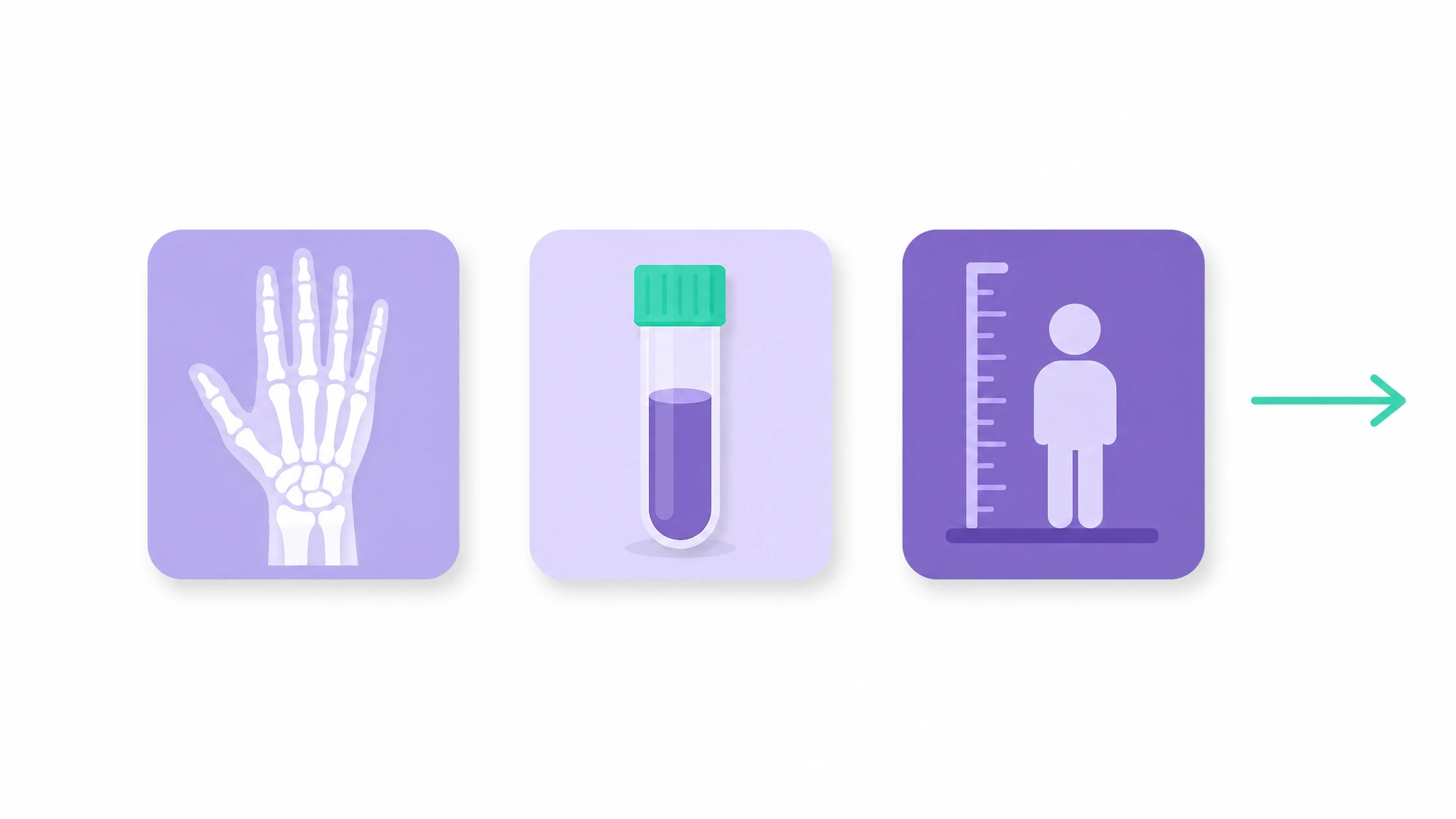
The answer should include a wrist X-ray for bone age and blood work. If a treatment is proposed before either exists, the plan was not built from your child.
Bone age is not a formality. Two children the same age and height can have years of difference in remaining growth, and that difference decides everything that follows.
Ask also what the blood work covers. Thyroid function and sex hormone levels change what a bone age means; liver and kidney function decide what can safely be prescribed. A clinic measuring only height and weight is not measuring the things that make the decision.
2. What Are You Treating, Specifically?

“Short stature” is a description, not a cause. Ask which factor is thought to be limiting growth in this child — hormones, early puberty, sleep, inflammation, absorption — and what in the results points there.
A clinic that can name the axis can also tell you what would change if it were addressed, and what would not.
This question also surfaces the opposite case. If nothing in the results is limiting growth, the honest answer is that there is time and nothing to start yet. A clinic that never gives that answer to anyone is worth a second look.
3. How Often Will You Re-Test, and What Would Make You Stop?

Any long treatment needs scheduled re-checks and a defined stopping point. Ask what is measured, how often, and what result would cause the plan to change or end.
“We would adjust if something appeared” is only meaningful if something is being looked at on a schedule.
For a treatment measured in years, the re-check interval is effectively how quickly a wrong plan can be caught. Ask what the numbers would have to do — bone age advancing faster than expected, velocity not improving, a blood value moving — for the plan to change.
4–5. Who Sees the Child, and Can You Do It From Where You Live?

Who reads the results and who explains them. Ask whether the same doctor follows the child across visits, and how many years they have spent on children’s growth specifically.
What is possible remotely. If you live outside the country, ask which steps can happen locally. A clinic used to overseas families will have an answer already — an English medical letter for local testing, results reviewed by video, and the in-person portion compressed rather than spread out.
If the answer is that everything requires being there, that is worth knowing before booking anything.
Continuity is the quieter half of this question. Growth treatment runs across years, and a child seen by a different doctor each visit loses the one thing that makes the record useful — someone who remembers what last year’s X-ray looked like and can say whether this year’s is a change.
6–7. What Are the Side Effects, and What Happens If It Does Not Work?

Side effects, stated plainly. Injection-site reactions, temporary headache or swelling are reported with hormone treatment. A clinic willing to say so is easier to trust with the rest.
And if the numbers do not move. Ask what happens then. The answer should involve re-examining which axis was blocked, not simply increasing what is already being done.
Growth depends on the individual child. Any clinic promising a specific number of centimetres is describing an outcome nobody can guarantee.
None of these seven questions has a trick to it. Together they answer one thing — whether the clinic is reasoning from your child’s results, or from a plan it applies to everyone who walks in. That distinction is visible in the first consultation if you ask.
FAQ
At what age should we first have a child’s growth checked?
Any point where growth over twelve months is under roughly 4cm, the child is around 10cm below peers, or puberty appears early is worth a check. The adjustable period lasts until the growth plates close, so earlier gives more room.
Is a bone age X-ray safe to repeat?
A hand-and-wrist radiograph is a low-dose study and is normally repeated at intervals of six to twelve months rather than frequently. Ask any clinic how often they intend to repeat it and why.
Can treatment be followed up from another country?
It can, depending on the clinic. Ask specifically about English documentation for local testing, video review of results, and how medication is supplied between visits.