The average height of elementary school students — how much is it by grade?
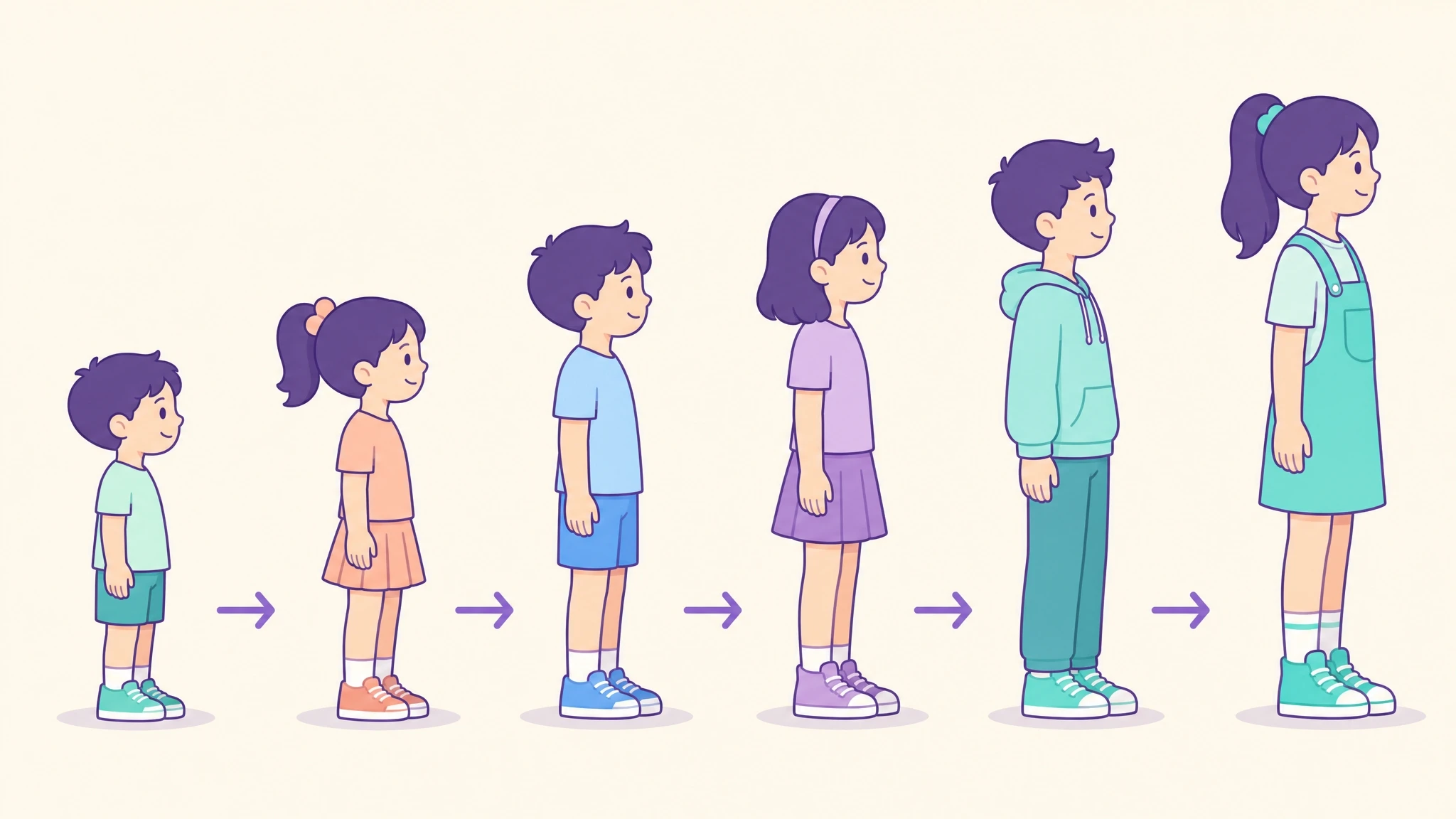
The average height of elementary school students by grade is information every parent has searched for at least once. According to the student health examination statistics released by the Ministry of Education and the Korea Disease Control and Prevention Agency, the average height of elementary school students has been trending slightly higher each year. As a rough benchmark, it starts at about 122cm for boys and about 121cm for girls in 1st grade (age 7), and reaches about 151cm for boys and about 152cm for girls by 6th grade (age 12). The phenomenon of girls overtaking boys in the upper grades occurs because the pubertal growth spurt appears earlier in girls. Since these figures are national averages, individual variation is substantial, and a difference of more than 10cm within the same grade is not uncommon. Rather than the number itself, it is important to also examine whether your child is steadily growing each year and whether their growth rate is being maintained.
The average height chart by elementary grade — how should you read it?

A concept commonly used in average height charts by elementary grade is the 'percentile.' The average (50th percentile) means the 50th tallest height among 100 children of the same age and sex, and below the 3rd percentile falls under the clinical criteria for short stature. There are two points parents should keep in mind when looking at the chart. First, check whether it is data measured in the relevant year. As the nutritional environment improves, the average steadily rises on a 10-year cycle. Second, consider the birth month. Even within the same grade, a child born in January and one born in December differ by up to 11 months, and the younger the age, the more pronounced this effect is. There is no need to worry right away just because the number on the chart is larger than your child's. What matters is observing the flow — through comparison of your child's height with peers — of whether their growth trajectory is being maintained consistently.
If your child is shorter than peers — checking for signs of growth faltering
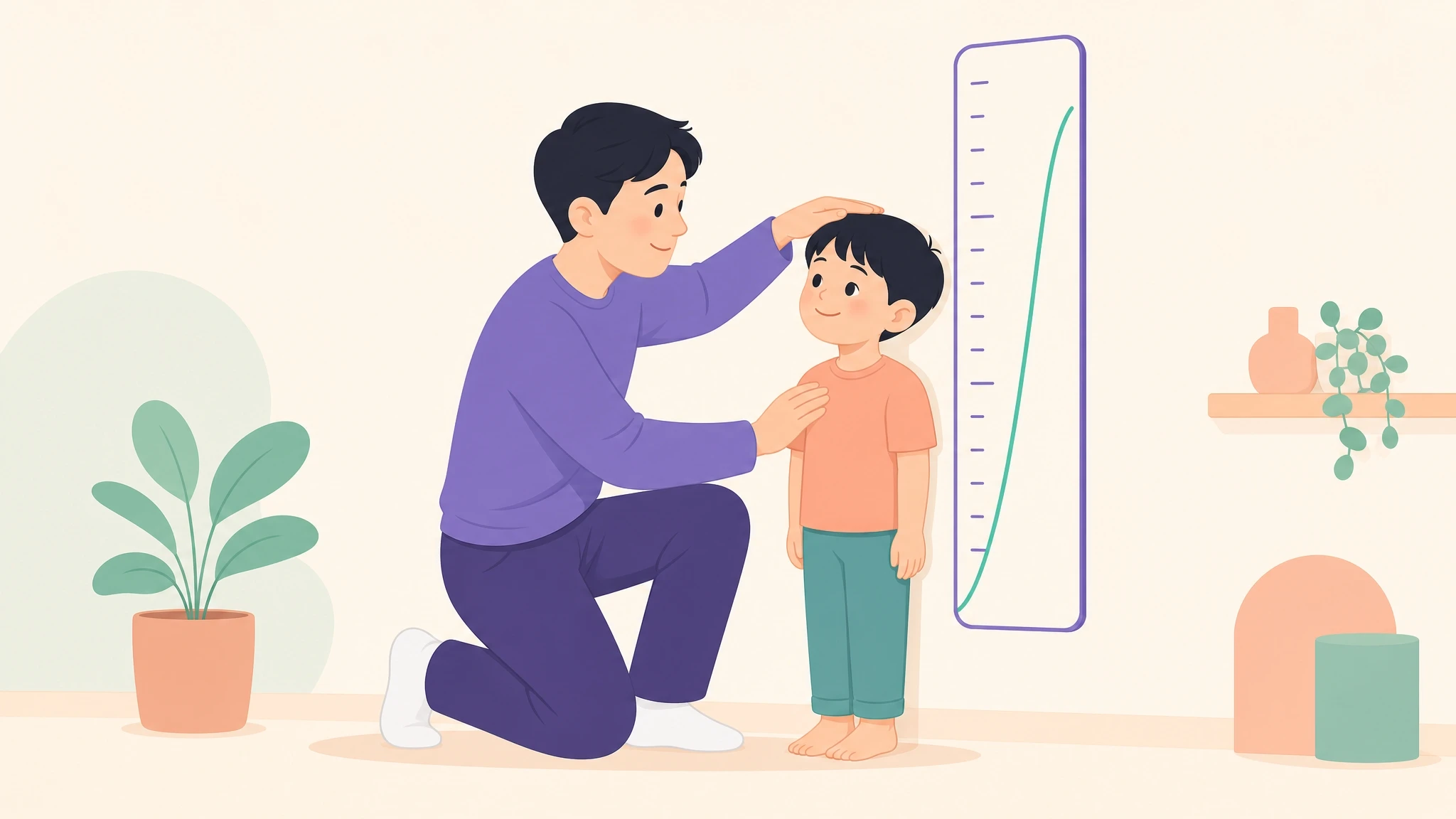
In comparing your child's height with peers, being shorter than average is not necessarily a problem for everyone. However, if even one of the signs below applies, it is worth looking a little more carefully.
- When the annual growth rate is less than 4cm — the normal growth rate for elementary school students is 5~7cm per year.
- When the growth curve bends or the percentile continuously drops — a trending decline, rather than a temporary plateau, requires examination.
- When the child is markedly shorter than peers to the point that they themselves are self-conscious — psychological withdrawal can raise stress hormones and affect growth doubly.
The causes of slow growth are varied, ranging from genetic predisposition, nutritional imbalance, lack of sleep, and excessive academic stress, to endocrine disorders such as growth hormone secretion problems or thyroid abnormalities. Because the approach differs depending on the cause, accurate identification of the cause should come before vague worry.
Elementary height growth standards — 5 factors that determine height

What deserves attention in elementary height growth standards is not the average figures alone. A child's final height is determined by multiple factors interacting with one another.
- Genetics: The influence of the parents' height is estimated at about 70~80%. However, since it is common for siblings with the same genes to differ by more than 5cm, how well the remaining environmental factors are managed is important.
- Nutrition: Protein, calcium, zinc, and vitamin D are directly involved in bone and muscle growth. Junk food and excessive sugar can trigger blood sugar spikes that hinder growth hormone secretion.
- Sleep: 60~70% of growth hormone is secreted during deep sleep (slow-wave sleep). The recommended sleep duration for elementary school students is 9~11 hours.
- Exercise: Aerobic and jumping exercises that give appropriate stimulation to the growth plates, such as jump rope, basketball, and swimming, naturally promote growth hormone secretion.
- Stress: Excessive private lessons or academic pressure raise cortisol secretion and act antagonistically to growth hormone. Emotional stability also affects height growth.
Why a bone age test is more accurate than comparing average heights

Simply comparing your child to an average height chart by grade is only a starting point. Even among children in the same 4th grade of elementary school, some have growth plates that are nearly closed, while others still have 3~4 years of growth potential remaining. The key test for distinguishing this difference is precisely the bone age (skeletal age) test. By evaluating the degree of bone maturity with a single X-ray of the left wrist and comparing it with the actual age, one can concretely grasp whether the current growth rate is appropriate for the child and how much growth potential remains. If the bone age is more than 2 years ahead of the actual age, there is a risk of premature growth plate closure, so earlier intervention may be helpful; conversely, if the bone age is younger, it means that sufficient growth opportunity still remains. Receiving a bone age analysis through a medical professional specializing in pediatric growth allows you to draw your child's own growth map — something that average height figures alone cannot reveal.
Growth hormone treatment is not necessary for every child

Parents interested in growth naturally become curious about growth hormone treatment. Growth hormone is a hormone secreted from the pituitary gland that directly promotes bone and cartilage growth, and in confirmed cases of deficiency, injection treatment can meaningfully improve the growth rate. However, simply scoring a bit low on an average height chart by grade does not immediately mean treatment is necessary. Treatment indications are limited to cases with a medically clear diagnosis, such as growth hormone deficiency or Turner syndrome. Whether or not to treat is judged by a pediatric growth specialist who comprehensively considers bone age, annual growth rate, and hormone secretion tests, and if necessary, treatment proceeds with a dosage and plan suited to the child. Rather than fixating on the average height number, examining your child's overall growth context together with a specialist is the wise starting point.
FAQ
What is the average height for a 10-year-old?
Globally, average height for a 10-year-old girl is approximately 137–138 cm and for a 10-year-old boy approximately 138–140 cm. These figures vary by ethnicity and region. More important than hitting this exact number is whether your child is tracking consistently along their own growth curve over time.
How do I know if my child's height is normal for their age?
Plot your child's height on a standard height chart by age and gender (such as CDC or WHO charts). A result between the 3rd and 97th percentile is generally considered within the normal range. If your child's position on the chart drops noticeably over a 12–18 month period, or if annual growth is less than 4 cm, consult a pediatric growth specialist for further evaluation.
Is a bone age X-ray safe for children and why is it useful?
Yes. A bone age X-ray involves a very low radiation dose — far below levels associated with health concerns — and is routinely used in pediatric medicine. It shows how mature your child's growth plates are relative to their calendar age, allowing specialists to estimate remaining growth potential and predicted adult height far more precisely than a standard height chart comparison alone.
References
- Variation in methods of predicting adult height for children with idiopathic short stature. Pediatrics. 2010. PubMed · DOI
- Prediction of adult height using maturity-based cumulative height velocity curves. The Journal of pediatrics. 2005. PubMed · DOI
- Adult height in constitutionally tall stature: accuracy of five different height prediction methods. Archives of disease in childhood. 1993. PubMed · DOI
- Prediction of adult height from height, bone age, and occurrence of menarche, at ages 4 to 16 with allowance for midparent height. Archives of disease in childhood. 1975. PubMed · DOI
- Prediction of adult height from height and bone age in childhood. A new system of equations (TW Mark II) based on a sample including very tall and very short children. Archives of disease in childhood. 1983. PubMed · DOI